

When hearing about personal injury cases, you will likely hear the word negligence. Negligence means that someone didn’t act with the same reasonable care that someone else would have exercised in the same circumstance. However, when a professional error leads to an injury, the legal terms can get confusing fast. You may have heard “negligence” and “malpractice” used interchangeably on TV, but in the real world, they are two distinct concepts. Understanding the distinction between negligence vs. malpractice is so important if you are considering a legal claim, as it dictates the evidence you need and the timeline for your case.
Negligence vs. Malpractice
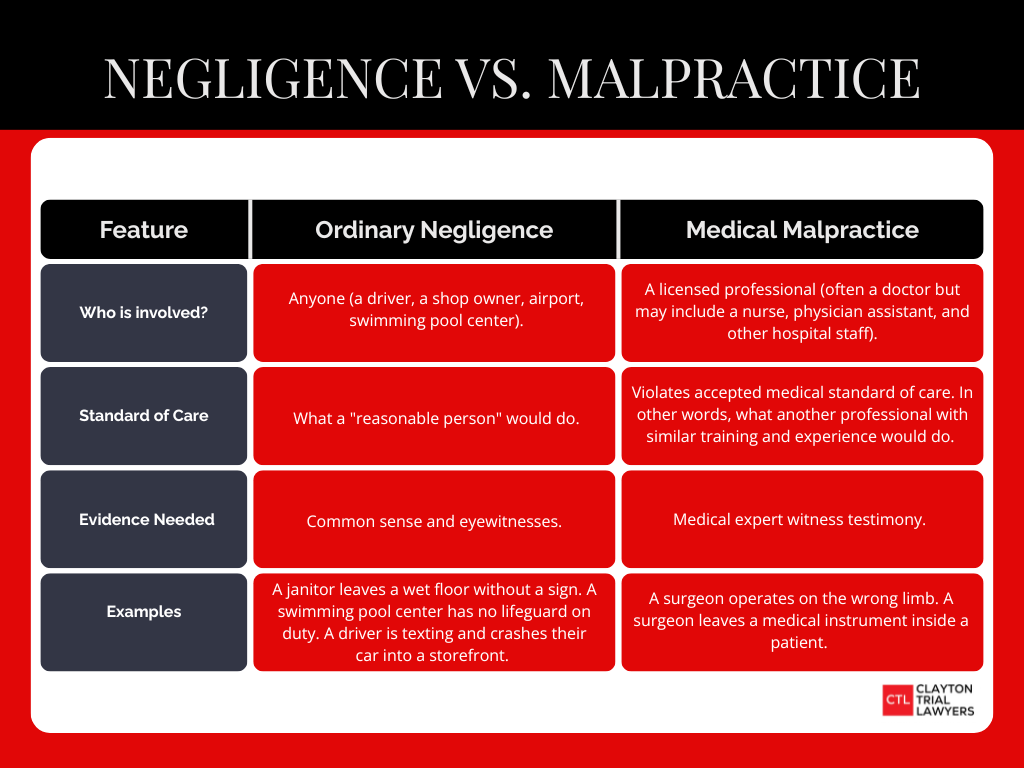
In the simplest form, negligence is a general term for carelessness. It happens when a person fails to exercise “reasonable care” that any ordinary person would in a similar situation.
Medical malpractice, on the other hand, is a specific type of negligence. It occurs when a licensed healthcare professional, who is acting in their professional capacity, fails to follow the “standard of care” established by the medical community.
What is Considered Medical Malpractice?
So, what is considered medical malpractice? To move from a simple mistake to a legal malpractice claim, the situation must meet four specific criteria. If one of these is missing, you likely don’t have a case.
- Duty: There was a formal doctor-patient relationship. This is often easiest to establish.
- Deviation (Breach): The doctor did something (or failed to do something) that a competent doctor in the same field would not have done.
- Direct Causation: The doctor’s mistake, not the patient’s underlying illness, is what caused the injury.
- Damages: The injury led to actual “losses,” such as more medical bills, lost wages, or permanent pain.
Common Examples of Malpractice
What is difficult to hear is that a bad outcome does not mean medical malpractice. A patient may suffer a devastating loss, such as paralysis from a spinal injury or a child may have severe developmental delays after birth trauma, but proving that a doctor’s mistake caused these injuries is often a hurdle in the legal world. A poor outcome may result from the patient’s pre-existing conditions or known risks of the procedure. Examples of errors that could constitute medical malpractice including the following:
- Misdiagnosis or Delayed Diagnosis: A doctor ignores clear symptoms of a burst appendix, leading a woman to develop an infection and lose function of one of her ovaries as the infection spreads to her pelvic region. She is of child-bearing age and loses one of her ovaries.
- Surgical Errors: A patient needs emergency back surgery after a fall at work. But the doctor performs the surgery on the wrong vertebrae, causing the patient to have a host of complications afterwards.
- Medication Errors: Prescribing a drug the patient is allergic to or giving the wrong dosage. For example, giving a toddler an adult dose of potassium through an IV and that leads the child to develop severe complications.
- Birth Injuries: Failing to perform an emergency C-section when Category III tracing is evident.
Why the Distinction Matters for Your Case
The reason the negligence vs. malpractice debate matters is that malpractice cases are significantly harder to win. This is due to a number of reasons.
- The Expert Requirement: In personal injury cases that involve negligence (like a slip and fall), a jury can use common sense to see who was at fault. In a malpractice case, you almost always need to hire an expert witness, another doctor, to testify that your physician made a terrible mistake.
- The “Pre-suit Affidavit of Merit“: In Florida, you cannot even file a malpractice lawsuit without a sworn statement from a medical professional saying your claim has merit.
- Statutes of Limitations: The deadline to sue for malpractice is two years from the date the injury occurred or from the date that the injury was discovered in Florida. If you wait too long, you lose your right to recover anything.
Figuring out whether a poor medical outcome crosses the line and constitutes legal malpractice is complicated. You need the help of a skilled attorney who can review the details of your case and get a medical expert to review your medical records. The expert must find that the healthcare provider’s actions fell below the “standard of care,” the specific level of skill and caution that a similarly trained professional would have used in the same situation. Having a bad outcome, as heartbreaking as it can be, does not necessarily mean malpractice. The provider must have made a specific mistake that caused your injury and the causation must be clear. That is why hiring an expert witness to testify that the provider deviated from accepted medical protocols is the first crucial step.
Furthermore, the case must involve “compensable damages,” meaning the error led to significant financial losses, physical disability, or profound suffering, rather than a minor inconvenience or a “near miss” that caused no lasting harm. For example, if a delayed c-section led to a complicated delivery but fortunately, the baby did not suffer lasting harm and seemed to meet developmental milestones, then even if the provider made an error, the damages are not relevant. There is likely no case.
Medical malpractice cases are notoriously consuming and in Florida, knowing that medical malpractice is distinct from your standard negligence personal injury case is helpful as victims navigate their next steps.