

We usually trust that when we enter a hospital we are in the best hands. We expect the doctors to be highly skilled, the nurses to be attentive, and everywhere to be sterile and clean. However, hospitals are high-pressure environments with a layered system of staff and management.
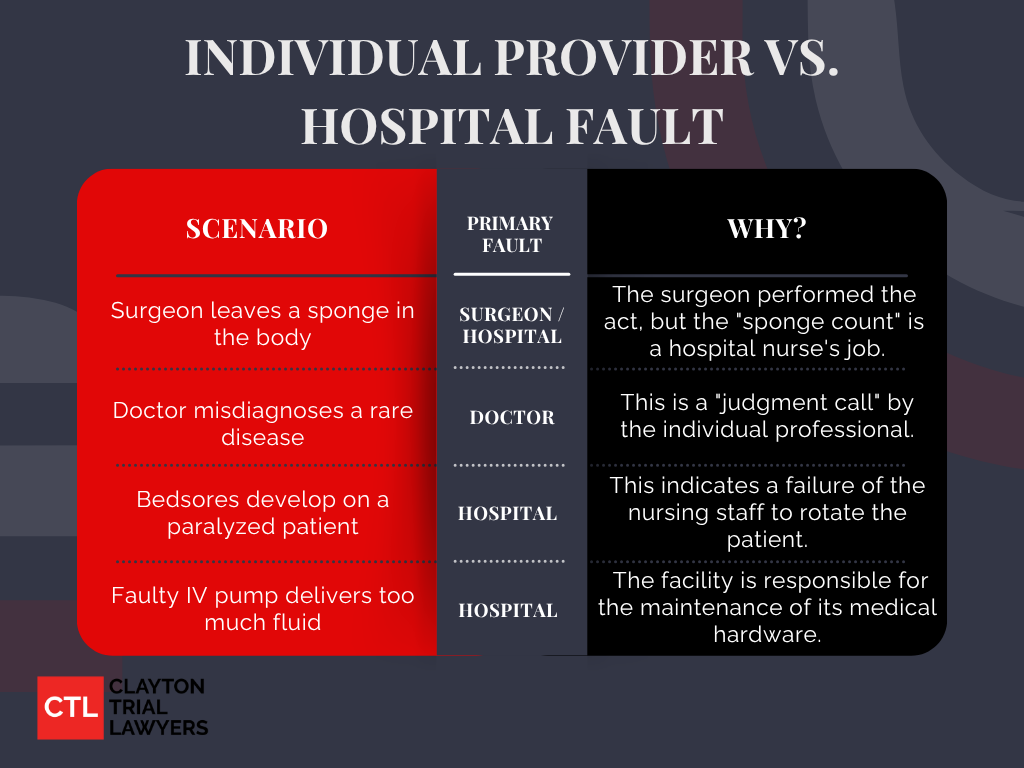
When we think of mistakes that happen at a hospital, we think of these errors in terms of a doctor making them. But there are a number of errors that result from hospital negligence, which is different from an individual physician failing to meet a standard of care.
What is Hospital Negligence?
Generally speaking, hospital negligence happens when a healthcare facility fails to meet the accepted standard of care, resulting in injury or death to a patient. While “malpractice” often refers to the specific, individual actions of a surgeon or physician, “hospital negligence” often looks at the administrative, systemic, and environmental failures of the institution itself. Under the legal doctrine of respondeat superior (Latin for “let the master answer”), a hospital can be held legally responsible for the actions of its employees. Furthermore, a hospital has a direct duty to maintain a safe environment and hire competent staff.
When is a Facility Held Liable?
Liability generally falls into two categories: vicarious liability and corporate negligence.
1. Vicarious Liability (Employee Errors)
If a nurse, technician, or pharmacist is a direct employee of the hospital (not an independent contractor) and makes a careless mistake while performing their job, the hospital is usually liable. However, there is a common “loophole” here: many doctors are actually independent contractors, not employees. If a non-employee doctor commits malpractice, the hospital may not be liable unless it failed to properly vet that doctor’s credentials.
2. Corporate Negligence (Systemic Failures)
This is when the hospital itself fails as an organization. This includes:
- Negligent Hiring: Hiring a staff member with a history of alcohol abuse.
- Understaffing: Having inadequate staff on the floor, such as nurses, leading to patient neglect and harm.
- Failure to Maintain Equipment: Using a malfunctioning ventilator or unsterilized surgical tools that leads to patient harm.
5 Common Medical Negligence Examples in Hospitals
To understand how these claims work in the real world, let’s look at the most frequent medical negligence examples where a facility is found at fault.
I. Medication and Dosage Errors
The hospital pharmacy is an essential part of the hospital. If a pharmacist misreads a chart, or a nurse administers the wrong dosage of a medication, the results can be severe, and in some cases, fatal.
- Example: A patient is prescribed pain medication. The nurse fails to check the dosage and administers three times the recommended amount, leading to an emergency need to reverse the opioid overdose with naloxone. Because the nurse is a hospital employee, this is a clear case of hospital negligence.
II. Hospital-Acquired Infections (HAIs)
Hospitals are breeding grounds for bacteria like MRSA or C. diff. While not every infection is “negligent,” a facility is liable if the infection was caused by a failure to follow sanitation protocols. Staph infections are common in hospitals and lead to 20,000 deaths a year.
- Example: A surgical team fails to properly scrub in or uses a room that wasn’t cleaned after a previous patient with a contagious infection. If the patient develops sepsis due to these hygiene lapses, the facility can be held liable.
III. Emergency Room Neglect and “Patient Dumping”
The ER is often chaotic, but that is not a legal excuse for not caring for those who are in need of treatment. Federal laws like EMTALA, Emergency Medical Treatment and Labor Act, require hospitals to stabilize anyone who comes to the ER.
- The Example: A patient arrives at the ER complaining of chest pain. Due to severe understaffing, the patient sits in the waiting room for four hours, suffers a massive heart attack, and dies. The hospital’s failure to triage and staff the ER properly constitutes negligence.
IV. Inadequate Monitoring and Falls
Hospitals have a duty to assess a patient’s “fall risk.” If a patient is groggy from anesthesia or medication and is left unattended, the facility is responsible for any resulting injuries.
- The Example: A patient with a high fall-risk score is left without bed rails or a bed alarm. They attempt to go to the bathroom alone, fall, and shatter their hip, leading to further impairment and pain. The failure to implement safety protocols is a systemic hospital error.
V. Laboratory and Diagnostic Errors
When a hospital lab loses a blood sample, mixes up labels, or fails to communicate a critical test result to a doctor, the “system” has failed the patient.
- The Example: A biopsy shows malignant cancer, but the hospital lab files the report in the wrong folder. The patient isn’t told for six months, by which time the cancer has spread. This delay in communication is a classic administrative failure.
The Elements of a Successful Hospital Negligence Claim
Proving hospital negligence is a technical process. To win a settlement or verdict, your legal team must prove four points.
- Duty of Care: You were a patient at the hospital, and they had an obligation to keep you safe.
- Breach of Duty: The hospital failed to follow standard protocols (they didn’t attend to you in the waiting room even though you had severe symptoms or didn’t check your ID band).
- Causation: The hospital’s specific failure, not your original illness, is what caused your new injury.
- Damages: You suffered real losses, such as additional surgery, lost wages, or permanent disability.
Why Hospital Negligence Cases Can Be Complicated
Unlike a car accident, you cannot simply look at a hospital error and determine fault. You often need to dig into paperwork called “Internal Quality Reports” and “Incident Logs” of the hospital, which they are often reluctant to share. You typically need an attorney to request these records.
Furthermore, many hospitals are owned by massive corporations with deep legal pockets. They often use a “deny and defend” strategy, hoping that the patient will give up or settle the case for a much lower amount. This is why having a clear timeline of events and copies of all medical records is vital.
Our trust is broken in cases of hospital negligence. Whether it is a result of a tired nurse, an unwashed hand, or a corporate decision to cut costs by reducing the number of staff, the consequences for the patient remain the same. If you or a loved one has suffered an injury that feels like it could have been prevented by better hospital oversight, it is important to act quickly. The “standard of care” exists for a reason: to ensure that when we go to a hospital to get better, we don’t come out worse. In Florida, patients or their loved ones have two years from when the injury occurred to file a lawsuit per Florida Statute 95.11(4)(b). However, Florida also imposes a “statute of repose,” meaning that in almost all cases, a claim cannot be brought more than four years after the actual incident, regardless of when it was found.